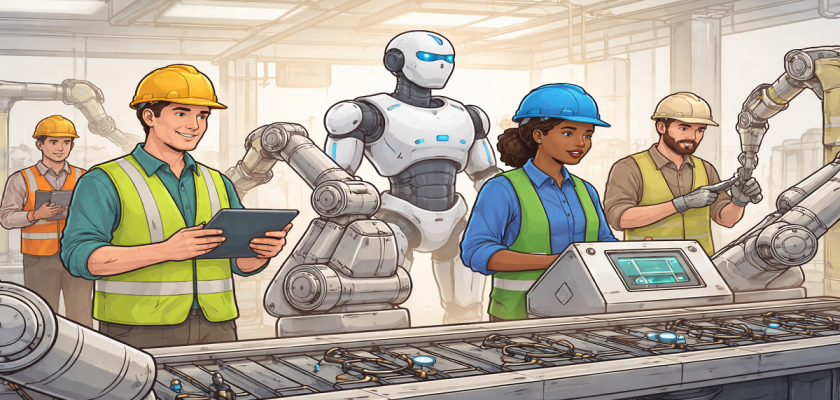
In the rapidly evolving global labor market of 2026, Artificial Intelligence (AI) is no longer a futuristic concept—it is a present-day reality that is actively transforming industries traditionally dominated by human physical effort. From vast construction sites in Dubai to automated warehouses in Germany and smart farms in Canada, AI-powered tools and robotics are becoming integral to daily operations.
While the word “AI” often sparks fear of job displacement, the reality in 2026 is much more nuanced. We are witnessing a transition from pure manual labor to a hybrid model where physical capability meets technical intelligence.
For the modern worker, staying relevant in this landscape requires a shift in mindset: moving from competing with machines to collaborating with them.
As we navigate through 2026, the pace of automation has accelerated due to breakthroughs in generative AI and robotics. However, this shift signals an evolution rather than an elimination of roles. Repetitive tasks are being automated, yes, but new, higher-value positions are emerging for those who understand how to navigate this new era.
This article explores the deep impact of AI on manual labor, the specific challenges workers face, and the critical skills you need to build a sustainable, high-paying career in an AI-driven world. If you are already working in the field, it is essential to understand how to upskill while working to ensure you are not left behind.
The Rise of AI in Traditional Manual Industries
In 2026, AI technologies like computer vision, machine learning, and autonomous robotics have moved beyond the laboratory and onto the factory floor. In the logistics sector, autonomous mobile robots (AMRs) now handle 60% of internal transport, reducing the need for manual heavy lifting but increasing the need for robot supervisors.
In construction, AI-powered drones perform site surveys with 99% accuracy, replacing traditional manual surveying methods. Similarly, in agriculture, smart sensors can now detect soil health and direct robotic harvesters to pick only ripe produce, drastically changing the nature of farm work.
These systems are designed to improve efficiency, reduce human error, and lower operational costs. However, they lack the human ability to handle “unstructured” environments—meaning that while a robot can sort a box, it cannot yet handle a complex on-site emergency or make nuanced ethical decisions. This is where the human worker remains irreplaceable.
Which Manual Jobs are Most Impacted?
Not all manual roles are affected equally. The impact of AI in 2026 can be categorized into three tiers:
- High Impact (Automation Heavy): Assembly line packing, basic machine operation, and standard warehouse picking. These roles involve repetitive, predictable motions that AI excels at.
- Medium Impact (Tech-Assisted): Heavy equipment operation, long-haul trucking, and inventory management. These workers now act as “Human-in-the-loop” operators, using AI to assist their tasks.
- Low Impact (High Human Judgment): Electricians, plumbers, specialized mechanics, and high-level on-site safety supervisors. These jobs require complex problem-solving in unpredictable environments that AI cannot yet master.
Opportunities: The “New Collar” Job Market
The transition to AI is creating what industry experts call “New Collar” jobs. These roles don’t necessarily require a four-year degree but do require specific technical certifications. For example, a traditional warehouse loader in 2026 might transition into an Automation Logistics Coordinator, earning 40% more than their previous salary.
By mastering AI tools, workers can access safer environments and more stable employment contracts. Furthermore, AI reduces the physical strain on the human body, potentially extending the working life of laborers who might otherwise have had to retire early due to physical wear and tear.
Challenges and the Digital Divide
Despite the optimism, the challenges are real. Job displacement is a primary concern for workers who lack access to retraining. The “Digital Divide” is also widening; workers who are not comfortable with smartphones or tablet interfaces are finding it harder to secure employment in modern factories.
Another challenge is the psychological stress of adapting to a fast-paced tech environment. Workers often report feeling “monitored” by AI algorithms. To cope with this, understanding mental health and wellbeing for overseas workers has become more important than ever as they navigate these high-tech changes.
Essential Skills to Stay Relevant in 2026
To thrive in this new era, manual workers must cultivate a specific set of “Future-Proof” skills. These are no longer optional—they are mandatory for anyone seeking visa sponsorship or high-paying international roles.
1. Advanced Digital Literacy
In 2026, digital literacy means more than just using a phone. It involves understanding how to interact with “Cobots” (Collaborative Robots), using wearable tech for safety monitoring, and basic data entry through voice-controlled systems. You must be comfortable navigating software dashboards that manage your daily tasks.
2. Predictive Troubleshooting
As machines take over the doing, humans must take over the thinking. Workers who can identify why an automated system is failing before it breaks down are highly valued. This requires a basic understanding of mechanical and electronic systems coupled with AI diagnostics.
3. Critical Problem-Solving
AI is brilliant at patterns but terrible at anomalies. When a construction project hits an unexpected geological obstacle, or a factory line has a unique mechanical jam, the human ability to innovate and solve problems on the fly is a premium skill.
4. Soft Skills and Team Collaboration
AI cannot lead a team, resolve a conflict, or show empathy. Communication, emotional intelligence, and teamwork are now “hard skills” in the industrial sector. Leadership roles in 2026 are going to those who can manage both human teams and AI systems effectively.
How to Protect Yourself from AI-Based Job Scams?
With the rise of AI, even the recruitment process has changed. Scammers are now using sophisticated AI to create fake job listings and sponsorship offers. It is vital for seekers to use a security checklist for visa sponsorship to verify if a high-tech job offer is legitimate. Always ensure that the company exists and their use of automation matches their official business profile.
The Role of Continuous Learning and Training
The concept of “learning a trade for life” is dead. In 2026, the successful worker is a “lifelong learner.” Many governments now offer subsidies for vocational training in robotics and automation.
Online platforms provide micro-credentials that can be earned in weeks. Employers are also increasingly offering on-the-job training as they realize that retraining an existing loyal worker is cheaper than hiring someone new.
FAQs About AI Is Reshaping Manual Labor Jobs
1. Will AI make manual labor jobs disappear by 2030?
No. While specific tasks will be automated, the demand for human manual laborers in “unstructured” and “complex” environments is actually expected to grow. The nature of the work will change, but the need for humans won’t.
2. Do I need to learn coding to work in a factory in 2026?
No, you don’t need to be a programmer. However, you do need to be comfortable using “Low-code” or “No-code” interfaces—basically, if you can use a complex smartphone app, you can operate most modern factory AI systems.
3. Are AI-assisted jobs safer?
Statistically, yes. AI is taking over the most dangerous “3D” jobs—Dull, Dirty, and Dangerous. This leads to fewer on-site injuries and better long-term health for workers.
4. How can older workers adapt to AI?
Experience is a huge advantage. Older workers have the “Intuition” that AI lacks. By pairing their years of experience with basic digital training, they often become the best supervisors for automated systems.
5. Which countries are leading in AI labor integration?
In 2026, Germany, Japan, South Korea, and Canada are at the forefront. If you are seeking sponsorship in these countries, highlighting your “Tech-adaptability” is a must.
6. Does AI reduce wages for laborers?
Initially, it may stagnate wages for unskilled roles. However, for those who upskill to become “AI-enabled workers,” wages are significantly higher than traditional manual labor rates.
7. What is a “Cobot”?
Short for Collaborative Robot, these are machines designed to work alongside humans in a shared workspace, unlike traditional industrial robots that operate in cages.
8. How do I prove my digital literacy to an employer?
Obtaining basic certifications in “Industrial Automation” or showing experience with warehouse management systems (WMS) on your CV is the best way.
9. Can AI help me find a job?
Yes! AI tools can help you optimize your resume and find job matches that fit your specific skill set faster than traditional searching.
10. What is the biggest risk of AI in the workplace?
The biggest risk is complacency. Workers who refuse to learn how to use new tools are the ones most at risk of being replaced by someone who does.
Conclusion
The transformation of manual labor through AI in 2026 is an opportunity for a global workforce upgrade. While the machines take on the repetitive and dangerous, humans are being called to rise into roles that require creativity, critical thinking, and technical oversight. The future of work is not a battle of Man vs. Machine, but a partnership where both play to their strengths.
By staying informed, continuously upskilling, and maintaining a proactive approach to technology, manual laborers can secure not just a job, but a thriving, long-term career in the digital age. The revolution is already here—make sure you are the one leading it.


