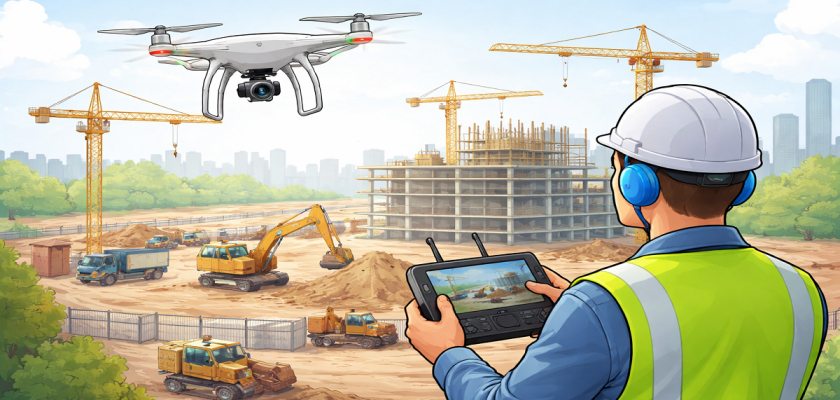
The construction industry has undergone a significant transformation over the past decade, and one of the most impactful innovations is the use of drones. As we step into 2026, drone operators have become an essential part of modern construction projects.
Their role is no longer limited to aerial photography; instead, they contribute to planning, monitoring, safety, and data-driven decision-making. For those looking to move beyond manual labor, this represents a major opportunity, similar to how we discussed transitioning manual skills to green jobs.
With the growing demand for efficiency, accuracy, and cost control, construction companies are increasingly relying on drone technology. Skilled drone operators are at the center of this shift, providing real-time insights and high-quality data that were previously difficult or expensive to obtain.
This guide explores the evolving role of drone operators in construction and why they are crucial for the future of the industry, especially for workers navigating the UK or Australian job markets.
Understanding the Role of Drone Operators in Construction
Drone operators in construction are responsible for capturing aerial data using unmanned aerial vehicles (UAVs). Their job involves more than just flying drones—they must plan flights, collect accurate data, and ensure compliance with strict aviation regulations.
They work closely with engineers, architects, and project managers to deliver actionable insights that support construction activities. In 2026, this role is often the next step for workers who have already developed strong leadership skills on-site.
In 2026, drone operators are expected to have both technical and analytical skills. They not only operate drones but also process data using specialized software to create maps, models, and reports that guide project decisions.
According to the Federal Aviation Administration (FAA), the integration of UAS (Unmanned Aircraft Systems) in industrial sectors is at an all-time high, creating a surge in demand for certified pilots.
Key Responsibilities of Drone Operators in 2026
Drone operators handle multiple responsibilities across different phases of construction. During the planning stage, they conduct site surveys to gather topographical data.
This helps teams understand terrain conditions and plan layouts effectively without the risks associated with manual site inspection. This level of technical oversight is essential for maintaining international safety standards.
During construction, operators monitor progress by capturing regular aerial images and videos. They track changes, identify issues early, and ensure that the project stays on schedule.
Additionally, they conduct inspections of hard-to-reach areas, such as high-rise rooftops or bridge underpinnings, reducing the need for dangerous manual checks and significantly improving safety for the entire crew.
Benefits of Integrating Drones into Construction Projects
The integration of drones into construction offers numerous advantages. One of the most significant benefits is improved efficiency. Tasks that previously took days or weeks, such as manual land surveying, can now be completed in hours using drones. This efficiency is vital for workers managing a healthy work-life balance by reducing overtime caused by project delays.
Cost savings are another major advantage. By reducing the need for expensive manual surveys and high-altitude inspections using scaffolding or cranes, companies can save both time and labor costs.
Drones also enhance accuracy, providing precise measurements and high-resolution data that help minimize errors in planning and execution. This precision is particularly important for high-stakes projects like heavy machinery operations in the Middle East.
How Drone Operators Improve Project Planning and 3D Modeling?
Drone operators play a crucial role in the planning phase by providing detailed aerial surveys. These surveys help construction teams visualize the site and identify potential challenges before work begins.
Using drone data, teams can create 3D BIM (Building Information Modeling) models and maps that offer a clear understanding of the terrain. This allows for better decision-making, reduces risks, and ensures that projects are planned more efficiently than ever before.
Enhancing Safety on Construction Sites
Safety is a top priority in construction, and drone operators contribute significantly to maintaining a safe work environment. By using drones for inspections, workers can avoid dangerous areas such as unstable ground or high-voltage zones.
Drones can quickly identify safety hazards, monitor compliance with safety protocols, and provide real-time updates. This proactive approach helps prevent accidents and ensures that ergonomic and physical safety standards are maintained throughout the project.
Data Collection and Advanced Analytics in 2026
In 2026, drone operators are not just data collectors—they are data analysts. They use advanced software like Pix4D or DroneDeploy to process aerial data and generate insights.
From volumetric calculations of gravel piles to thermal imaging for heat leaks, drone data helps construction teams make informed choices.
This data-driven approach improves efficiency, reduces waste, and enhances overall project outcomes, fitting perfectly into the future of construction technology.
Skills and Certifications Required for Modern Drone Operators
The role of drone operators has evolved significantly, requiring a diverse set of skills. While technical expertise in flying is a baseline, operators must now understand construction workflows. Key skills include:
- Aviation Certification: Obtaining a Part 107 (USA) or RePL (Australia) license.
- Software Proficiency: Knowledge of mapping and 3D modeling tools.
- Technical Understanding: Basic knowledge of construction blueprints and site layouts.
- Safety Compliance: Deep understanding of extreme weather protocols for safe flight operations.
Regulations and Compliance in Drone Operations
Operating drones in construction requires adherence to strict local and international regulations. In 2026, regulatory frameworks have become more structured, ensuring that drone operations are safe and standardized.
For foreign workers, this often involves validating their foreign licenses or attending local training programs to stay compliant and avoid legal issues in countries like Canada or New Zealand.
Future Trends: AI-Driven Autonomous Drones
The future of drone technology in construction looks promising. We are moving toward autonomous drones that can perform pre-programmed site sweeps without human intervention.
Integration with Building Information Modeling (BIM) systems and AI sensors allows drones to detect structural deviations in real-time, making the drone operator more of a “fleet manager” than just a pilot.
FAQs About Role Of Drone Operators In Construction
1. Do I need a pilot’s license to fly a drone on a construction site?
Yes, for commercial work, you must obtain a specific UAV pilot certification from your local aviation authority (like the FAA in the US or CAA in the UK).
2. How much can a drone operator earn in 2026?
Depending on the country and skill level, drone operators can earn between $50,000 to $90,000 annually, significantly higher than general labor roles.
3. Is the job physically demanding?
No, it is much less physically demanding than traditional construction roles, though it requires long periods of standing and high mental concentration.
4. Can I transition from a laborer to a drone operator?
Absolutely. Many companies prefer internal promotion because a former laborer already understands the site’s layout and safety risks.
5. What is the most difficult part of the job?
Managing data and ensuring the drone stays safe during extreme weather or in high-interference areas are the biggest challenges.
6. Do I need to buy my own drone?
Usually, the construction company provides the industrial-grade equipment, though many freelancers own their own backups.
7. What software should I learn?
Learning AutoCAD, Revit, and drone mapping software like DroneDeploy is highly recommended.
8. How long is the training?
Basic certification takes a few weeks, but mastering the analytics software can take several months of practice.
9. Are there sponsorship jobs for drone operators?
Yes, because it is considered a “Skilled Trade,” many companies offer visa sponsorship for certified pilots.
10. Is it a safe career choice for the future?
With the rise of smart cities and modular building, drone technology is one of the most future-proof skills in the industry.
Conclusion
The role of drone operators in construction has evolved into a critical component of modern project management. As technology continues to advance, their contributions in planning, safety, monitoring, and data analysis are becoming increasingly valuable.
In 2026 and beyond, drone operators will remain at the forefront of innovation, helping construction companies achieve greater efficiency, accuracy, and success. For foreign workers, this career path offers a gateway to higher pay and better working conditions.


